Valerie Hsiung is a poet who writes between worlds, where language meets ritual and abolition meets afterlife. Drawing on diasporic, ecological, mystical, and metaphysical inquiry, her books dissolve the borders of poetry, prose, performance, and philosophy into a single listening body. She is the author of eight full-length books, including The pedestrian (Nightboat Books), The Naif (Ugly Duckling Presse), The only name we can call it now is not its only name (Counterpath), and To love an artist (Essay Press). Her writing has appeared more recently in Common Place Poetics, Chicago Review, The Georgia Review, Annulet, mercury firs, and The Nation, and her work has been presented internationally at Double Change (Paris), Hyle (Athens), Giselle’s (Marseille), Hop Scotch (Berlin), and the Jaipur Literature Festival. Her essay on the language of secret revenge was published in Literary Hub. Recipient of fellowships and residencies from the Camargo Foundation and Lighthouse Works, the Inaugural Lodestar Award for Individual Artists from Beneath the Wild Sky Foundation, as well as grants from Foundation for Contemporary Arts and PEN America, she teaches writing at the limits of language at the Jack Kerouac School of Disembodied Poetics at Naropa University. Her ceremonial work and pedagogy has been studied by researchers on the subject of emancipatory practices including Sophie Orlando. Born to Chinese-Taiwanese immigrants in Cincinnati, Ohio, she now lives in the foothills of Colorado. [Contact]
"Why are some people’s pores open in their aloneness? Valerie Hsiung asks, in this, the most—maybe only—honest biography I’ve ever read. Is it a biography? It is the consequence of a porousness (i.e. of being perforated) that seems to be the consequence, in turn, of being made to live the impossible state of perpetual estrangement as self-enchantment, the impermanent state of metamorphosis as permanence. Hsiung’s writing has accompanied and seen me through so many incarnations; I am ready for what The pedestrian will make of me—will make of all of us—next.“
- Brandon Shimoda
"The pedestrian is a map to a terrain of shards and shadows. While reading it, I felt lost only to the land of the normative, a lush fugitivity. I traveled far with, because of, and in this book. Hsiung trusts in the politics of decomposition, making syntaxes that have been distorted by grief, and thus sharpened to what cannot be colonially extracted. Writers like this know that grammar, vocabulary, and the sentence itself are haunted, so they write not to exorcise or cure this condition of its ghosts, but to make a place for them to live, a place they belong.“
- Johanna Hedva
"Two is a confounding number, asserting, through its adjacency to one, the split from which consciousness proceeds. In the third person, Valerie establishes a self in two parts, living two lives, witnessing in memory an architecture of diasporic remembrance at odds with Proustian time. The past in The pedestrian is cellular—replicated, split, migrated— its membranes stretched by Valerie’s devoted prose, its unsentimental attunement to the fray of love and loss. She renders what’s closest—a mother, a house, a child—radically extimate. An inversion inviting, at the turn of every mundane gesture, history’s ravenous ghost (eating is always a reminder of hunger). Legs splayed open, birthing herself with each new paragraph, She is a revelation. She shows how perfect the sentence can be as a place to keep the wound active. A staggering act of containment enabling us to remain in touch with the break, and to find, in the split, all of life’s surplus.“
- Mirene Arsanios
- Brandon Shimoda
"The pedestrian is a map to a terrain of shards and shadows. While reading it, I felt lost only to the land of the normative, a lush fugitivity. I traveled far with, because of, and in this book. Hsiung trusts in the politics of decomposition, making syntaxes that have been distorted by grief, and thus sharpened to what cannot be colonially extracted. Writers like this know that grammar, vocabulary, and the sentence itself are haunted, so they write not to exorcise or cure this condition of its ghosts, but to make a place for them to live, a place they belong.“
- Johanna Hedva
"Two is a confounding number, asserting, through its adjacency to one, the split from which consciousness proceeds. In the third person, Valerie establishes a self in two parts, living two lives, witnessing in memory an architecture of diasporic remembrance at odds with Proustian time. The past in The pedestrian is cellular—replicated, split, migrated— its membranes stretched by Valerie’s devoted prose, its unsentimental attunement to the fray of love and loss. She renders what’s closest—a mother, a house, a child—radically extimate. An inversion inviting, at the turn of every mundane gesture, history’s ravenous ghost (eating is always a reminder of hunger). Legs splayed open, birthing herself with each new paragraph, She is a revelation. She shows how perfect the sentence can be as a place to keep the wound active. A staggering act of containment enabling us to remain in touch with the break, and to find, in the split, all of life’s surplus.“
- Mirene Arsanios
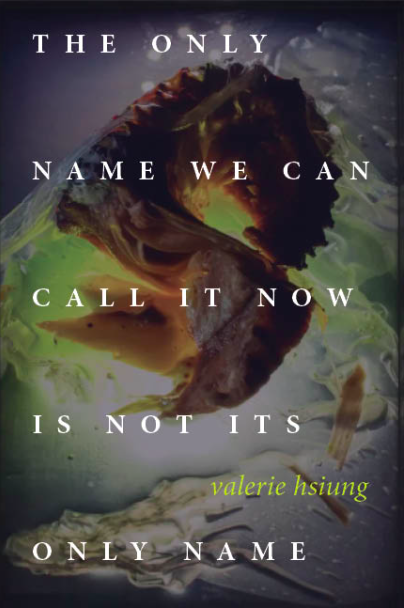
“The only name we call it now is not its only name moves immediately beyond the realm of the bound book into an aeriel and psychedelic projection of mind, a continuously unfolding pattern that we can only ascertain from above the earth and through the concurrent music of clashing fragments. Hsiung’s text maintains its velocity and charm through perfectly timed peripheral detail giving way to the crystallized ongoing, luminous present. I never wanted to leave this book as it so closely illustrates the way a poet thinks back on reality: posing words as free-floating enclosures, sound being used as a necessary weapon of defense and our experience of being surrounded by language, helpless to continue listening and binding and throwing the line back out in new, unquantifiable formations.”
- Cedar Sigo
"The pedestrian is intimate as an ultrasound of the past, revealing a many-chambered organ haunted by someones, somethings and others. A cross between medium and technician, Valerie Hsiung meticulously probes the uncanny gap between before and after with a language devised for this purpose and no other. Precise, unflinching and subtle, Hsiung’s sentences shift to meet the unspeakable where it lives—within.“
- Anne de Marcken
"Silky grief, kinetic gaps and dislocations, and a potent, trance-like narration that brushes and brushes against the inarticulable. Valerie Hsiung’s The pedestrian is entirely outside of category, awakening nerves long dormant through its gorgeous obliquity, its charge of fresh music. The hypnosis is plainly startling, entangling the reader and guiding her into the most otherworldly of spaces: the other worlds rushing forth, ungovernable, inside this one. In place of the usual tired meanings comes the largesse of mystery and deeper, stranger voices. The pedestrian is an antidote ampule to memory’s cliches. No, not just memory’s cliches—to any force that conspires to sever the dreaming from the waking.“
- Jenny Xie
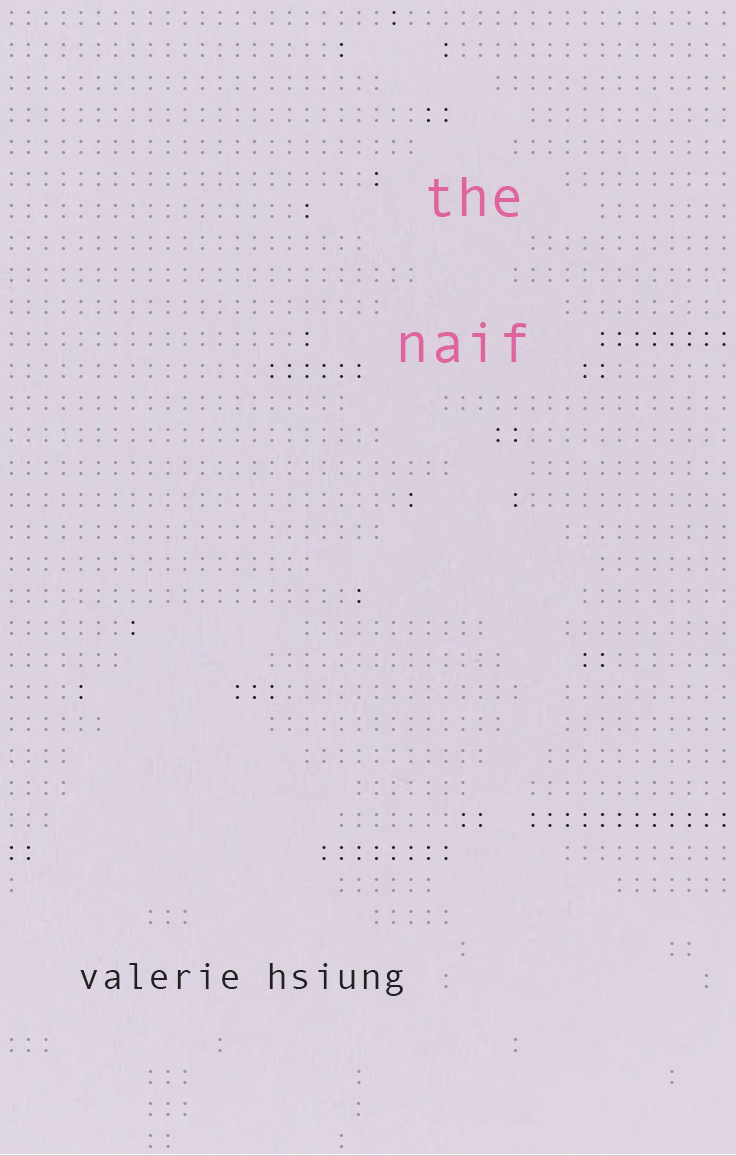
“Is it innocence to think that if you hold onto something long enough (community, relationship, attention) the habitual will give way to the extraordinary? The “person of insouciance” relating this logbook narrative evolves through the willful and unsuspecting ironies that threaten to foil the aim of artists and revolutionaries alike. The Naif so deranges intention with particulars—that is, with wonder—as to turn everyday fact into speculative fiction. A new way of living may yet prevail, thanks to Hsiung’s encouragement, akin to the spores of a mushroom, or to winning the lottery, waiting for us all along, as though in advance of the beginning.”
- Roberto Tejada
“A philosophical rumination that pulls us all the way into its depths, The Naif is an abstract painting made of words and sentences and punctuation or lack thereof, a distant memory whose skin you get to touch and feel as you attempt to find your way through its centers and peripheries. The Naif is an attempt for “reconciliation” between what we try to do in life while we have “already gone off course,” while we navigate an intimate piece of clothing dangling on a chair, cheese, mouse, juice gone bad, a lamp, a gift shop, all the what and the who of the everyday guiding us toward the word “transcend.” Kneading a slippery “new way of life” into a shape that is shifting and grounding, Valerie Hsiung shares with us her being in and out of community, in intimacy and in selfness. She invites us to “conduct ourselves according to the pulse of each other without losing the pulse of ourselves” while we immerse ourselves in the pulse of her beautiful language offering.“
- Poupeh Missaghi
- Anne de Marcken
"Silky grief, kinetic gaps and dislocations, and a potent, trance-like narration that brushes and brushes against the inarticulable. Valerie Hsiung’s The pedestrian is entirely outside of category, awakening nerves long dormant through its gorgeous obliquity, its charge of fresh music. The hypnosis is plainly startling, entangling the reader and guiding her into the most otherworldly of spaces: the other worlds rushing forth, ungovernable, inside this one. In place of the usual tired meanings comes the largesse of mystery and deeper, stranger voices. The pedestrian is an antidote ampule to memory’s cliches. No, not just memory’s cliches—to any force that conspires to sever the dreaming from the waking.“
- Jenny Xie
“Is it innocence to think that if you hold onto something long enough (community, relationship, attention) the habitual will give way to the extraordinary? The “person of insouciance” relating this logbook narrative evolves through the willful and unsuspecting ironies that threaten to foil the aim of artists and revolutionaries alike. The Naif so deranges intention with particulars—that is, with wonder—as to turn everyday fact into speculative fiction. A new way of living may yet prevail, thanks to Hsiung’s encouragement, akin to the spores of a mushroom, or to winning the lottery, waiting for us all along, as though in advance of the beginning.”
- Roberto Tejada
“A philosophical rumination that pulls us all the way into its depths, The Naif is an abstract painting made of words and sentences and punctuation or lack thereof, a distant memory whose skin you get to touch and feel as you attempt to find your way through its centers and peripheries. The Naif is an attempt for “reconciliation” between what we try to do in life while we have “already gone off course,” while we navigate an intimate piece of clothing dangling on a chair, cheese, mouse, juice gone bad, a lamp, a gift shop, all the what and the who of the everyday guiding us toward the word “transcend.” Kneading a slippery “new way of life” into a shape that is shifting and grounding, Valerie Hsiung shares with us her being in and out of community, in intimacy and in selfness. She invites us to “conduct ourselves according to the pulse of each other without losing the pulse of ourselves” while we immerse ourselves in the pulse of her beautiful language offering.“
- Poupeh Missaghi
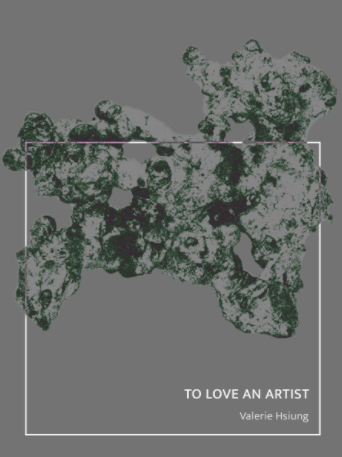
“Valerie Hsiung’s To love an artist is a work composed of dislocations--or rather, durations, expanses of dislocated voices, bodies, and narratives. It is a series of studies on ductility and leaching--what we are at our base and what we become when brought, whether violently or voluntarily, in proximity to others, other species of being, other modes of existing, other methods of naming: the lines we cross, “Language from bronze infects language from copper.” When the poet writes, “Today, I speak a language of brutes,” I read the enfoldment of the cruelty our collective and respective histories into the languages of our subjectivity. Any expression of self or free-ness or united-ness is laden with material and intentions that do not belong to us. We have been mixed forever, we have been poured and burned through borders always, and are ourselves burned and poured through. And that is why it is useful to invent forms for the expression of our alloyed selves, to be non-knowing. To love an artist presents a despondent, broken, scattered form. Yet, it pulses with nuance and engagement. It’s beautiful, irreverent, and dangerously incoherent. It stays with you when you’ve stopped reading it and puts your seeing in disarray. It nourishes and it fails and it teaches. This is a book of refusal. It is a cosmography written as metallurgy; it wants to be the dust and it wants to be the friction.”
- Renee Gladman
- Renee Gladman
“To love an artist is to be drawn into her world so that you become a co-creator with her; To love an artist is to enter both a bestiary and topiary of language where the latter contorts and morphs through strange yet recognizable beauty; To love an artist is to enter the worlds of philosophy, history, politics, and most importantly the quotidian—passing seamlessly from poetry, to the essay, to reflection, to observation while remaining always within the landscape of poetry, as you navigate its repetitions and obsessions and become co-creator; it is to witness the play inherent in language as it meanders “the abyss between literacy and what (the poet) meant to say.” To love an artist is to indulge in a form of disquisitionary poetics with a sometimes wry humour and all the while looking at the world aslant. It is astonishingly original work—To love an artist.”
- M. NourbeSe Philip
- M. NourbeSe Philip
“This book descends like a feral cloud from the abyss, able to change the weather of its reader through a hypnotic, swaying performance. A multidimensional braid of gestural vibrancy and "autobiographical transnational history" threads this temporally fluctuating lyric graveyard of intimate energies. Hsiung reminds readers to "slow down the vessel" to consider the ways in which the poet ionizes meaning, memory, and language itself, blurring the "frames within each frame" into new organisms rising and singing from the worm-rich mulch of The only name we can call it now is not its only name."
- Angel Dominguez
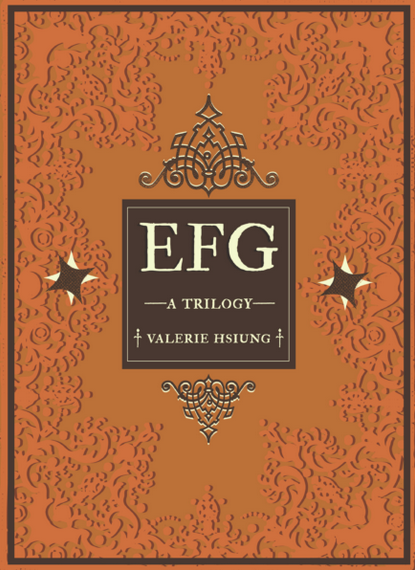
- e f g (Action Books, 2016)
-
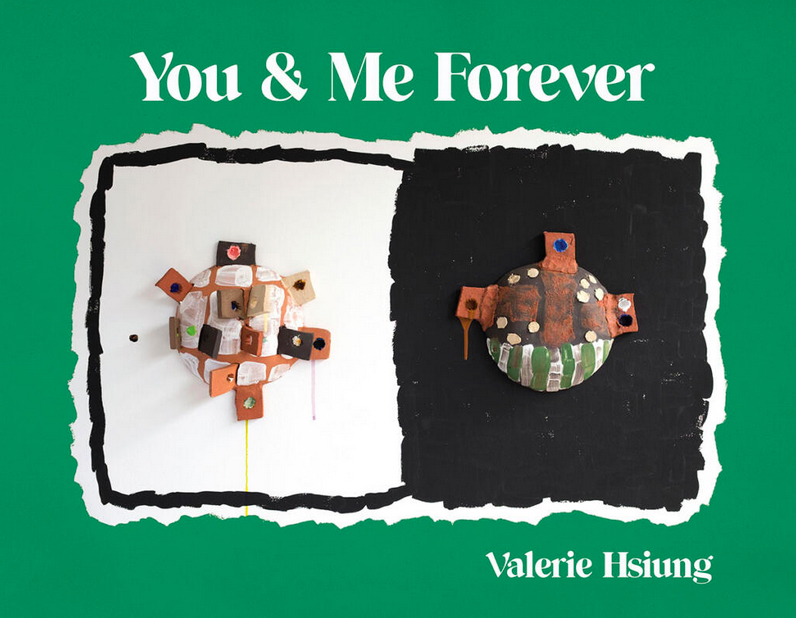
YOU & ME FOREVER (Action Books, 2020)
-
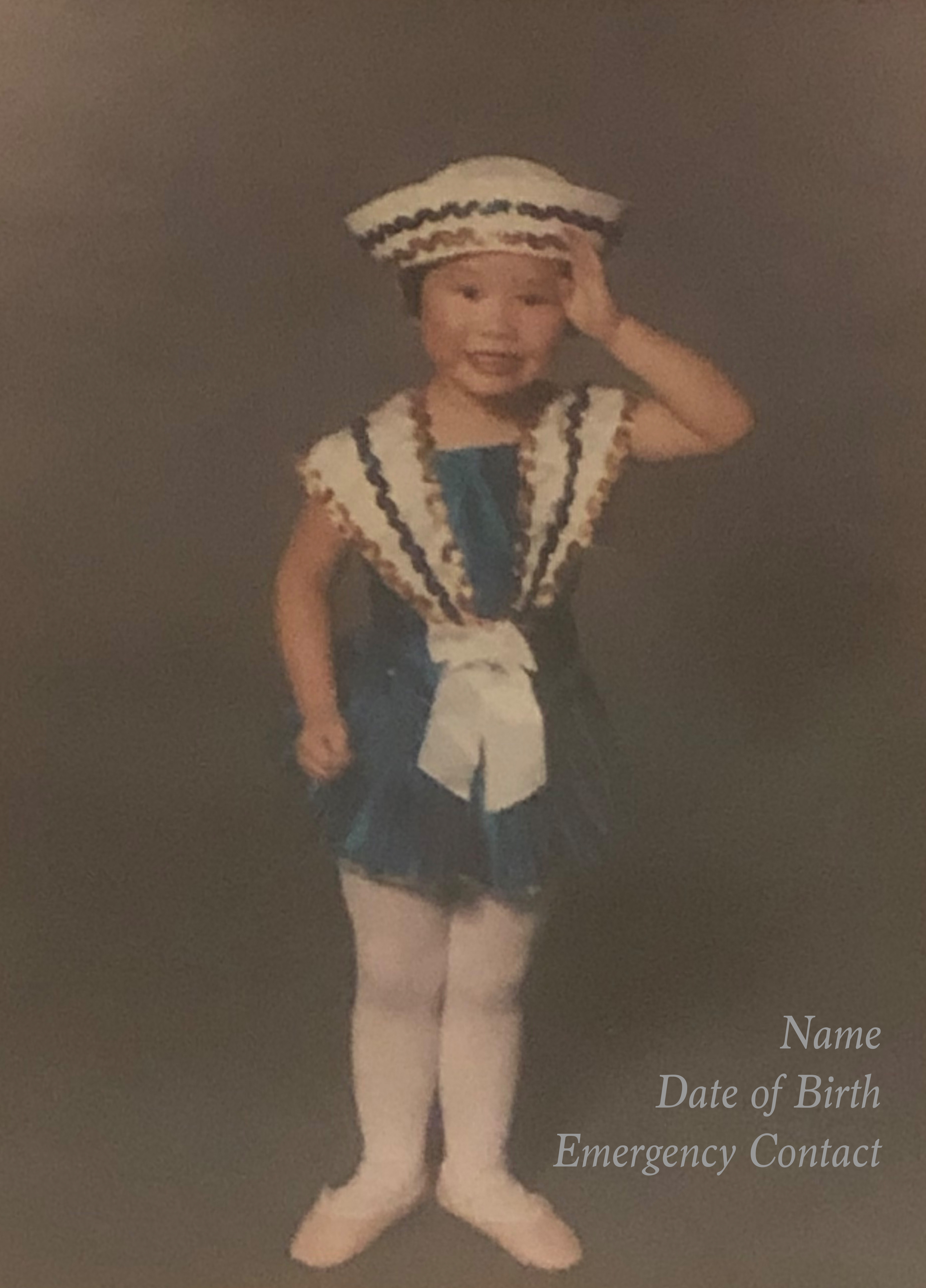
Name Date of Birth Emergency Contact (The Gleaners, 2020)
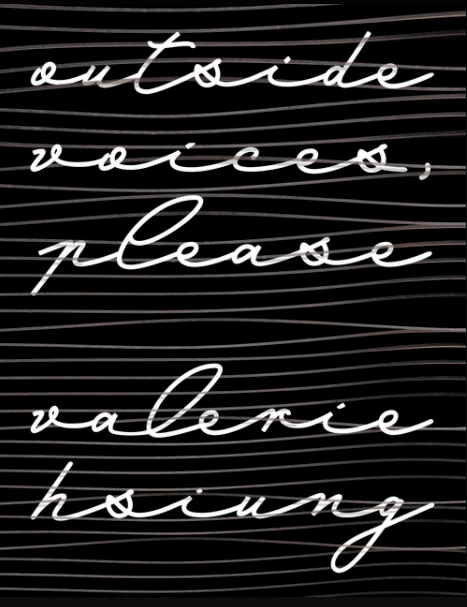
- outside voices, please (CSU, 2021)
- To love an artist (Essay Press, 2022)
- The only name we can call it now is not its only name (Counterpath, 2023)
- The Naif (Ugly Duckling Presse, 2024)
- The pedestrian (Nightboat Books, 2026)

Excerpt from Evolution in
Common Place Poetics
Excerpt from The pedestrian in
Chicago Review
Essay on Yodel & The Poetics of Revenge in
Literary Hub
Excerpt from The Naif in
The Georgia Review
Excerpt from The only name we can call it now is not its only name in
Annulet
Excerpt from A-begging in
mercury firs
Excerpt from The only name we can call it now is not its only name in
Black Sun Lit
Excerpt from The only name we can call it now is not its only name in
BathHouse Journal
A superstitious poem in
The Nation
Excerpts from Pearls and Hostending in
Paperbag
Interview in Nightboat Blog with Lucia Kan-Sperling, 2026
Review in Bombay Gin Journal by estel franklin, 2026
Review in Ghost Harmonics by Ginger Ko, 2026
Review in The Whitney Review by Funto Omojola, 2026
Interview in Bombay Gin Journal with Stacie Moore, 2026
Review in The Poetry Project Newsletter by imogen xtian smith, 2023
Interview in BOMB Magazine with Angie Sijun Lou, 2023
Review in Cleveland Review of Books by Megan Jeanne Gette, 2023
Review in Full Stop Magazine by Isabel Sobral Campos, 2023
Interview in Matter Monthly with Tiffany Troy, 2023
Review in Tupelo Quarterly by Amanda Auerbach, 2022
Interview in Tupelo Quarterly with Mary-Kim Arnold, 2022
Interview in Exclamation’s Gaunlet with Clarissa Jones, 2022
Review in Angel City Review by Anahita Safarzadeh, 2020
Interview in Tarpaulin Sky Magazine with Julia Cohen, 2020